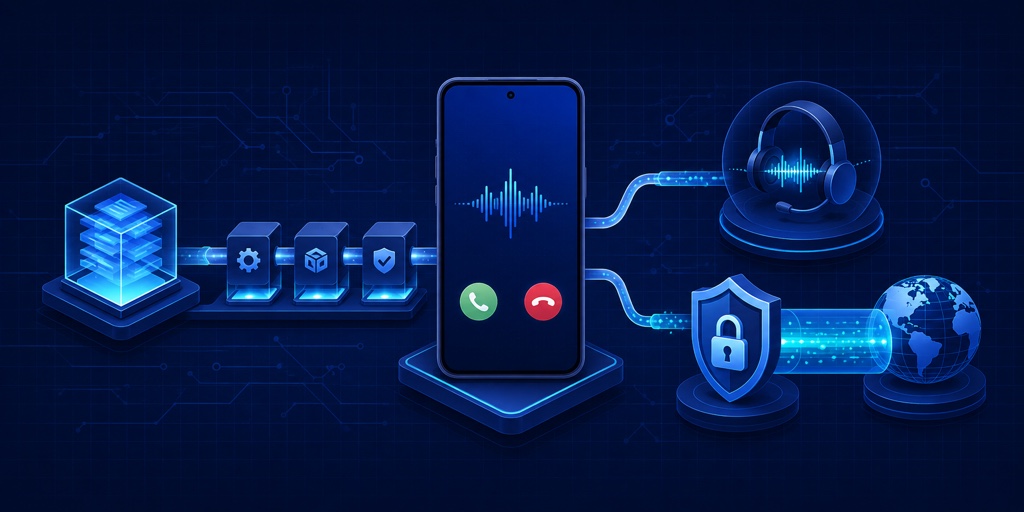
In 2019, a reader asked whether our WhatsApp clone included VoIP. I said no. It would require native integration, and the setup was too much for that project. For years, that was the line.
VPN sat behind the same line. These features do not live neatly inside the application process. On iOS, a VoIP push can arrive before the application installs a Java listener, yet CallKit expects the incoming call to reach the lock screen on its deadline. A Call Directory integration is a separate extension executable with its own lifecycle and signing identity. Managed VPN adds Network Extension entitlements and profile rules. Android solves the same jobs through ConnectionService, VpnManager, VpnService, manifest declarations, and foreground-service rules.
Wrapping those APIs in Java is the small part. A cross-platform runtime cannot add a service before installation, answer a native callback before the application is ready, or create and sign another executable inside the application bundle. Once every team must maintain those pieces in Xcode and Android Studio, the shared abstraction has stopped at the hardest part.
Codename One has a secret weapon for that problem: builders.
Builders already assemble the native product, so they can change its shape based on the Java packages the application actually uses. They link frameworks, inject permissions and background modes, generate native delegates and services, and create extension targets when needed. Leave a package out and its native machinery stays out too.
PR #5604 is where we crossed that old line. It introduced first-class call management, VoIP push handling, managed VPN, and the packet-tunnel API and Android host. PR #5693 completes the iOS path by generating a separately translated and signed Network Extension. The Java API is the visible result. The bigger change is that builders assemble the system integration around it without turning every application team into the maintainer of two native build projects.
TL;DR
Callsconnects application call state to CallKit on iOS and self-managedConnectionServiceon Android. Your media and signaling stack remain yours.Vpninstalls and controls managed IKEv2 profiles on iOS and Android. iOS also supports managed IPsec profiles.VpnTunnelexposes raw packets for an application-implemented tunnel on Android and iOS. The iOS builder work generates and signs a separate Network Extension containing the translated Java tunnel.- Dialogs and secondary windows now work together, including an opt-in native modal window.
- The new AppKit port builds a real Mac application instead of presenting an iOS application through Catalyst.
- SMS one-time-code autofill fills a verification code without asking to read the inbox.
- A daily platform watch now turns Apple and Google notices into source-level checks before deadlines become fires.
- The new Contact Picker returns selected contact data without broad address-book access.
A call is a system session before it is a media session
A VoIP application has two timelines. Its signaling server and media engine have one. The operating system has another. On iOS, an incoming VoIP push must be reported to CallKit immediately. The Java application may not be running yet. On Android, a self-managed connection participates in system call routing and audio focus even when the application’s own screen is elsewhere.
The new API keeps those responsibilities separate:
if (!Calls.isSupported()) {
    return;
}

Calls.configure(new CallConfiguration()
        .displayName("Acme Talk"));

Calls.addActionListener(new CallActionAdapter() {
    public void answerRequested(String callId, CallAction action) {
        signalling.accept(callId);
    }

    public void audioSessionActivated(CallAudioSession session) {
        media.start(session.getCallId());
    }

    public void providerReset() {
        media.stopEverything();
    }
});
Calls does not choose a codec, move audio packets, or invent a signaling protocol. It owns the bridge to the system call UI and lifecycle. The application starts media only after the native audio session activates, not merely because the user tapped Answer.
The package boundary also carries meaning. com.codename1.call.session adds the core system call integration. com.codename1.call.voip adds PushKit and the iOS VoIP background mode. com.codename1.call.directory adds directory integration without silently pulling in the self-managed calling permission. Apple can reject an application that declares VoIP background execution without using it, so importing less code must build less native machinery.
The simulator supplies deterministic call and audio-session events. That makes the awkward orderings testable before a build reaches a phone.
Managed VPN with an important platform boundary
Many enterprise applications do not implement a VPN protocol. They install an operating-system profile and ask the platform to connect it. That path now has one Java API:
if (!Vpn.isSupported()) {
    return;
}

VpnProfile profile = new VpnProfile("vpn.example.com")
        .protocol(VpnProtocol.IKEV2)
        .remoteIdentifier("vpn.example.com")
        .localIdentifier("alice")
        .usernamePassword("alice", secret)
        .displayName("Acme Corporate");

Vpn.install(profile).onResult((ok, err) -> {
    if (err == null) {
        Vpn.start();
    }
});
iOS and Android 11 or newer support managed IKEv2. iOS also supports managed IPsec with a pre-shared key. The operating system owns user consent, credential storage, and the active configuration. The API exposes those boundaries rather than storing a VPN password in application preferences.
The packet tunnel boundary
For work that does not fit a managed VPN profile, VpnTunnel lets application code inspect raw IP packets and decide whether to forward or drop them:
public final class LocalTunnel extends VpnTunnel {
    public LocalTunnel() {
    }

    protected void onStart(TunnelConfiguration configuration) {
    }

    protected void onPacket(PacketBuffer packet) {
        if (packet.getFamily() == PacketBuffer.FAMILY_IPV4) {
            forward(packet);
        }
    }

    protected void onStop(TunnelStopReason reason) {
    }
}
The same Java packet loop runs on Android and iOS, but the process boundary is different. Android hosts it in a VpnService inside the application process. iOS requires a NEPacketTunnelProvider Network Extension: a separate executable with its own bundle identifier, provisioning profile, memory limit, and translated VM. The builder work in PR #5693 creates that target, translates from the selected VpnTunnel class instead of the UIKit application shell, adds the framework and entitlements, and embeds the signed extension in the application.
The iOS extension contains the translated tunnel and VM, but not the Codename One networking stack. It can inspect, rewrite, drop, and forward packets on the device. It cannot open a remote connection through com.codename1.io.Socket, ConnectionRequest, or ParparVM’s java.net. Android can relay packets because its tunnel runs in the application process. A protocol that needs a remote relay should put that transport behind a platform-specific interface instead of assuming the two hosts are identical.
Apple grants the Network Extension entitlement case by case, so the target is deliberately opt-in. Once the App ID has that entitlement, name the tunnel class in codenameone_settings.properties:
codename1.arg.ios.vpn.tunnel=true
codename1.arg.ios.vpn.tunnel.class=com.acme.LocalTunnel
codename1.arg.ios.appext.CN1VpnTunnel.provisioningURL=https://example.com/CN1VpnTunnel.mobileprovision
Both the host application and <packageName>.vpntunnel App IDs need Apple’s Network Extension entitlement. The extension also needs its own provisioning profile. It starts fresh, requires an accessible no-argument constructor, and cannot see application statics or Display. Pass local configuration through TunnelSetup.data and read it in VpnTunnel.onStart(). This is a real cross-platform API without pretending the two operating systems have the same lifecycle or networking facilities.
The builder is part of the runtime contract
A browser application cannot register CallKit, a self-managed Android connection service, or an Apple Network Extension. Flutter, React Native, and .NET MAUI can reach those APIs through native plugins and platform projects. The difficult work then lives in target membership, manifests, entitlements, background modes, native delegates, and signing.
Builders change where that difficult work lives. The build server already owns the native product graph. It can see which Java packages survive into the application and generate the platform pieces that match them:
delegates and modes] C --> A[Android services
permissions and manifest] C --> E[Extension targets
and signing preflight] C --> S[Simulator implementation] U[Unused packages] --> N[No native baggage]
Dependency injection cannot do this work. The builder can add a service that must exist before Java starts, compile a native callback that meets an operating-system deadline, and sign an extension as part of the same product. Application teams keep control of their UI, protocol, and business logic without maintaining a parallel native build system.
Dialog can become a native modal window
Last week’s native-window release named several components that still assumed every top level was a Form. PR #5624 closes most of that list. Dialog, Sheet, ToastBar, combo-box popups, floating-action submenus, progress overlays, tooltips, and HTMLComponent now resolve the window that contains them. Accessibility state is tracked per window as well.
A dialog can remain a lightweight overlay inside its owner, or opt into a real operating-system window:
Dialog.setDefaultNativeWindowMode(true);
boolean delete = Dialog.show(
        "Confirm deletion",
        "Delete Quarterly report.pdf?",
        "Delete",
        "Cancel");
The window follow-up covers precedence, fallback behavior, anchored popups, and the remaining limits.
A Mac application built on AppKit
Mac Catalyst helped us get an iOS application onto macOS, but its desktop behavior remained bounded by UIKit. It could not supply several ordinary window operations, and a secondary 4K surface could require roughly 33 MB for each intermediate frame before the image was copied into place.
PR #5601 replaces the default Mac native path with AppKit. The generated application now owns NSApplication, NSWindow, NSMenu, NSScreen, and a CAMetalLayer per window. Always-on-top, utility windows, minimize, restore, maximize, native modality, and independent dirty-region painting are real desktop operations.
The AppKit article explains the rendering change, build targets, test evidence, and the native accessibility bridge to VoiceOver.
OTP without inbox permission
PR #5642 adds a one-time-code constraint plus reusable phone-number and verification components. On iOS, Android, and the web, the operating system can offer the code from an SMS without giving the application permission to read messages.
PhoneVerification verification = new PhoneVerification();
verification.setCodeSender((number, response) ->
        server.sendCode(number, response));
verification.setCodeVerifier((number, code, response) ->
        server.verifyCode(number, code, response));
verification.addVerifiedListener(evt -> showAccount());
Codename One does not send or verify the SMS. Your server still owns expiry, attempt limits, rate limits, and session issuance. The OTP article includes both the complete component and the lower-level text-field option.
Stop learning about platform changes from failed builds
Until this week, an Apple or Google change usually reached us through a community report. That is useful, but it starts the clock after somebody is already exposed.
We now run a daily scheduled Codex task that reads official platform notices, extracts the requirement and date, traces the affected Codename One producer, and checks for an existing issue or fix. It found the Android 16 back-navigation gap repaired in PR #5673, and the privacy direction that led to the Contact Picker in PR #5680.
The task does not make a notice true, and it does not replace platform tests. Its job is to connect a primary-source deadline to the exact builder, generated project, or API that must change. The platform-watch article shows that chain. Contact selection gets its own code-focused article because the permission model deserves more than a paragraph.
Four smaller changes with a large blast radius
Google Play Billing 8
PR #5651 moves the default Android billing dependency to 8.0.0 and completes the move from the retired SKU API to ProductDetails. Google’s billing deprecation schedule now makes version 8 the minimum for updates. The builder absorbs a generated-project migration that most application teams should never have to chase themselves.
JavaScript density now means device pixels
PR #5634 fixes display width, height, and millimeter conversion when the browser device-pixel ratio is neither one nor two. A viewport that is 390 CSS pixels wide at a ratio of three now reports 1,170 device pixels.
This can change layout and screenshot results in existing JavaScript applications. Read CN.getProperty("browser.window.devicePixelRatio", "1") when a breakpoint genuinely needs CSS pixels.
The mouse wheel is no longer a fake drag
Desktop ports used to translate one wheel turn into a press, three drag events, and a release. That could trigger a click when nothing scrolled. PR #5660 routes native wheel events directly.
Built-in scrolling finds the nearest scrollable ancestor. A custom component that consumes wheel input should now override mouseWheel(WheelEvent) or register a listener:
chart.addMouseWheelListener(evt -> {
    WheelEvent wheel = (WheelEvent) evt;
    if (wheel.isControlDown()) {
        zoomBy(wheel.getDeltaY());
        evt.consume();
    }
});
The developer guide became a maintained product
We removed obsolete IDE and Ant-era guidance, folded the Maven workflow into the main book, restored missing samples, and reworked the order of several chapters. More important, CI now checks the guide’s structure, cross-references, promised code blocks, served links, images, prose, and generated output.
Documentation drift is now a failing build instead of a cleanup project for some future week. The restored call, VPN, desktop, security, identity, event-thread, graphics, and performance material is part of the release contract.
Native reach with narrower defaults
This week stretches Codename One in both directions. Calls, VPN profiles, AppKit windows, contact selection, and OTP reach deeper into each operating system. Package-triggered builders keep that reach narrow. An application does not receive VoIP background execution because another product needed it. It does not receive broad contacts access to pick one person. It does not gain a message-reading permission to fill six digits.
Secure-by-default programming depends on small public APIs, generated native integration, explicit platform limits, and fewer opportunities to turn a convenience feature into permanent access. You still own the application UI and the protocol choices. The builders absorb the native product plumbing needed to ship them.
Start with the Call Management or VPN chapter, then test the failure path in the simulator before sending a native build.
Discussion
Which native capability have you avoided because the platform project was harder than the application code?